Showing posts with label thinking. Show all posts

Tuesday, October 11, 2022

Black and White Thinking


Today I was working with a student who dismissed a website because of "bad grammar". When I looked at the site, I didn't see anything that would have caused me to dismiss it. 


Is it so easy?


The other day I was in a classroom where the teacher was having students use the CRAAP test. The website's tagline in the screenshot above says, "Evaluating sources easily". It is not easy to evaluate sources online. The C in CRAAP stands for current. Are current sources more reliable? Are John Dewey or Marie Curie not reliable sources?

A framework is a good starting point, but if we are not teaching students to look laterally, leave sites and check the author's credentials as well as reviews about the site, we are in danger of leaving them to think that if one of the criteria is not met, a site is not reliable.

It needs to be made explicit that one little miss on the test does not mean that the whole site is trash.

Sunday, July 16, 2017

Which creative style do you most relate to?

In a review of the book, The Launch Cycle, Matt Miller describes several different ways people approach creativity then poses the question: Which one do you most relate to?

  • the artist, who loves to make things from scratch
  • the geek, who is fascinated by systems and structures
  • the architect, who crafts things from the systematic side
  • the engineer, who focuses on fixing problems
  • the hacker, who tears things down to build something better
  • the point guard, who makes a difference and creates opportunities 
  • (He missed this one) The astronaut is the teacher who is always exploring new ideas 

    If I had to choose two, I would definitely say that I am either the engineer or the point guard. Honing in on one though is more difficult. I am confident in the two I chose if for no other reason than I came back to this assignment after six months and my choices are the same as before.

    • What does it mean to have a bigger definition of creativity?
    Teachers should be on the lookout for creativity in the process as well as in the final product. Creativity can manifest itself in any subject.
    • How are certain creative types misunderstood?
    Often creativity is misunderstood or interpreted differently by different people. I am reminded of the student who painted a picture and another teacher remarked how "powerful" it was. I didn't see it.
    Different people can show their creativity differently. Some people need more time to make the connections necessary to be creative in the first place. Students might need to do a gallery walk or some additional reading/viewing before jumping in to allow their creativity to show through. 


    • Why is it important to have a maker mindset?
    The maker mindset consists of the skills students need to learn. It teaches them to be more flexible with their thinking and solve problems or challenges.

    I was going to write the word "real", but not all challenges are something they might encounter in the real world. However, the challenges allow students to think through and solve problems at hand with the tools and resources available. 

    In that sense, the problems are "real".


    • What is the risk in failing to develop a maker mindset?
    I think the risk in failing to develop a maker mindset is that the jobs of today, as well as the future, demand the skills of a maker mindset; flexible thinking, making connections, improvising, being creative, and thinking critically.

    I think this is where we teachers risk failing to prepare our students for life after schooling.


    From Education Closet, but I forgot the link

    Saturday, February 11, 2017

    Design a Flag

    In the end, we teachers are really just salespeople. If the students aren't interested in what they are learning, it is harder to motivate them to learn. But when students are eager, there is no stopping them.

    In our MYP Design course, we aim to push students to use authentic clients. When they have an actual client, the whole design process is actually easier for them since they are able to discuss what the client wants.

    A few student-created flags. Can you guess where they are from?


    In the beginning of the year, we used design scenarios - one of which being a Design a Flag scenario I adapted from a 99PI episode on flag design. (And looking at it again, I forgot to have them first design a one-by-one-and-a half inch flag. Note to self.)

    Some students did pretty well, but those who weren't interested were lost through the whole project.

    Next time ... 
    Reflecting on the unit, I wonder how it could have been made more engaging. Could I have had all them make a flag for the country, city, family (clan), or the school? That way they could brainstorm and draw inspiration from each other as well as share research. This feels like something I would do in elementary school, though.

    If I were to try this project again, I might use 99designs.com. They have design projects that might be good for students to follow the design process when someone has written out the directions beforehand. It also gives them an authentic chance to design for a client.

    Also, I forgot that it is recommended you design your flag on a 1" by 1.5" rectangle. That way you can judge how it might look from a distance and keep the objects simple.


    Friday, December 19, 2014

    Making Fairy Tale Thinking Visible

    When I do visible thinking routines in my class, I usually do them as a group to help guide the process and model my own thinking for them. 

    This has gone pretty well, but recently I have noticed some students not thinking to their potential. The time had come to push them a little more.

    I had planned on doing this as a group, but in an attempt to make it a little different, I gave each student the sheet below.


    When I was thinking of this post, I at first reflecting on this lesson, I thought giving the students a worksheet like this was the wrong idea. But now that I reflect on this a little more, I think this was a good step for the students.

    In the beginning of the lesson, I went through each question as a class and wrote ideas down on the board so they would be able to copy some words. For whatever reason, hopefully it was because of the holidays, the students were not focusing.

    Then I gave them their own sheet and allowed them to work with partners or in groups. I think these routines best serve [young] students when they are able to gain insight by listening to others' ideas. I believe that this "idea sharing" helps push thinking further.

    I think the issue here was that the students were overconfident. They thought they knew what to do. They did not need to discuss the story because they knew it.

    Maybe I need to sell this better next time.

    Or maybe I should do this in the morning instead of the afternoon.

    **Follow up note: While working their way thorough this, one of my first graders said, "Hey. I can read this!" Maybe that alone made this lesson worth doing.

    Monday, June 9, 2014

    Rainy Day Activity - Make Three Equal Groups

    Most of Japan is in the midst in the rainy season. Rainy season is sandwiched in between spring and summer.

    Today was a rainy day. I dread rainy days; especially when I am on recess duty. The students seem especially energetic on rainy days, and not having a chance to run around outside can cause some problems.

    Right in the middle of an outdoor recess today it started raining enough so that we had to come inside. When all the students were in, I began sorting them into three lines. The students were being slow and two of the lines were much longer than the third.


    Having seen this before, and knowing that it would take the rest of the recess period to get them lined up, I made a snap decision and called out, "Stop!"

    "Divide yourselves into three equal groups."

    From there the students spent the next five minutes trying to figure it out. It was interesting to see which students did not follow directions correctly and started making groups of three. There were some students who were not engaged, and some who were confused (I think confusion is a good thing for a little while), but it was a good problem for a rainy day.

    It was interesting to see some of the older students who knew how to solve the problem try to line up the students to make the groups.

    Tuesday, October 1, 2013

    Asking Questions and Showing Your Answers


    This year I have been trying to place an emphasis on questioning; both for myself and for my students.

    When we have Show and Tell time and the speaker asks if there are any questions, there is always someone who says "I like that."


    Is this one of my first graders?

    So I am getting more practice in with simply asking questions.

    For our current unit, our math focus is graphing. This is giving us a lot of practice asking questions when we survey other students.

    To start with I am having the students do a one question bar graph. So today they brainstormed what question related to families they wanted to ask. After some students had already gotten up and started their surveys, one student was still sitting at his table.

    I asked him what he was doing. He looked at me and he said, "I am thinking."

    Think away.


    A dragon watches over us.

    Thursday, September 26, 2013

    A Focus on Thinking

    In August our elementary team discussed what we would focus on for the year in our monthly elementary assembly. The last two years we focused on the environment and our responsibility towards it.

    At the end of last year I suggested that we group students into multi-age groups, give them a few periods a week for a month in which to work on a project, and then present what they did at our monthly elementary assembly.

    Well, that  idea did not fly.

    So this past August when discussed what our theme should be I suggested thinking and helping students develop better thinking strategies. Then I suggested that we, as a team, read Making Thinking Visible.

    This time, it flew.


    I bought the book last year, and read some of it, but I was excited to get a chance to read it with my colleagues in a "book club" setting.

    We read Chapter 1 last week and we discussed it. It is interesting reading and discussing the book with others and seeing their insights.

    I am looking forward to seeing where this goes.

    Sunday, June 9, 2013

    Poem

    We learned a lot this year.
    We learned we could have fun with a group of more than two,
    We discovered a new sense of independence,
    We found our voice and learned to communicate what we thought,
    We learned that doing hard things can be fun,
    We found new ways to connect and new ways to find information,
    We surprised our teacher by what we could do,
    We learned to take risks and we pushed ourselves outside of our comfort zone,
    We learned that the times when we thought we would not have fun, we could,
    We found that being under the lights can be scary, but we can do it,
    And we found out that everyone in the class and learn, and sometimes the oldest one in the room will learn the most.


    Tuesday, May 21, 2013

    Combining Making Thinking Visible Activities

    Honghe Rige Terrace Micro-Ecology
    via Visual.ly
    While planning for my current unit about the ecology of rice fields (ecosystems, food chains, and life cycles) I came across the above infographic on Visual.ly. Thinking it could make an interesting provocation, I printed it onto an A3 piece of paper and put it up in the front of the room on the first day of the unit.

    Wanting to focus on the rice field in the upper left, I asked my class what they saw.

    When they started talking about the people, I knew I had to take it further.

    I started by taking out some See, Think, Wonder sheets I made up, and I covered up most of the picture, so they focused on the terraced rice field.

    Image 1

    Despite seeing the picture beforehand, when I asked what they saw in the small square, I still got interesting responses like fossil and alligator tail. After discussing their responses a little, we wrote them down and moved out.

    As I zoomed out more, I again asked what they saw. This time I got responses like mountain, stairs, and one student said rice field.

    Image 2

    The students talked a little about the woman, but surprisingly, since I was focused on the terrace, they were too. They ignored the field to the top. I asked them to write down what they think about the image.

    Honghe Rige Terrace Micro-Ecology
    via Visual.ly


    When I pulled back the curtain, again, I told them that it was indeed a rice field. I think every student's hand went up and the air electrified. Finally, I asked them if they had any wonderings or questions. I had them write them down.

    I really like going through the questions the students have after they get worked up about a topic like this.

    I will be ready for this in the start of the units from now on. This was as interesting as when I showed the students pictures of rice field art.


    Monday, May 6, 2013

    Time to Vote For Your Stars!

    On the first Monday of every month the whole elementary school gathers together to group, recently showing off student work (which I think is great and I would like to see this continue), and to recognize students who have been outstanding at exhibiting our STARs [ESLRs].

    Students who have been "living the STARs" receive an award and are recognized for their excellence. I have watched the older grades now for two years choose their own class nominees while I have sat back and chosen the STARs for my own class.

    Today I decided it was time to put the ball into their court and let them choose their own STAR recipients.


    It was a revealing experience. For one, the students were much more serious about it than I had expected. We discussed it for about 45 minutes - a long time for my class to talk about something. The conversation also showed me how superficial their knowledge of the STARS, ESLRs, attitudes the school [and I] want the students to exhibit.

    How many times did someone ask me today what each one of them meant. Was it that they only understood the meanings of the words in one way and were unable to apply them?

    Whatever the reason, it helped me see that I should be doing this every month. I think it is a great way for the students to learn more about what they mean outside of the "cookie cutter" definition they usually learn.

    I set it up so that we first reviewed what the STARs were, in our case they are Responsible, Open minded, Communicator, Knowledgeable, and Risk Taker [ROCKR]. I then asked the students to nominate another student who had shown that trait in the last month.

    This was hard for them, and it was even hard for me, as I think that we tend to think more about people's actions as an accumulative rather than in segments of time as I was asking them.

    I thought it was good for students who were voted for to hear their name called. I think that it is important for students to that others are watching their actions - even if they don't think so. An act that one might think of as inconsequential, can be enormous for another. And vice versa.

    I am wondering, as I am going to start doing this regularly, if it will motivate students to start thinking more about their actions. One student told me after the [secret ballot] votes were in, that she was disappointed she didn't get the knowledgeable award. I told her I was sorry, but maybe she could try to think more about what image she was projecting when she was interacting with others, and that she could even try to make her good deeds more visible to others.

    I really don't want to start a competition here, and if it starts to become one I will have to tweak something, but for today, and for the next and last assembly of the year, the decision will be in the students hands.

    As it should be.

    Monday, March 25, 2013

    One and a Half

    Today we ventured into fractionland.

    I usually do random pairings, but today I paired my students up into teams and gave them some Play Dough. Then I gave them 5 minutes to mess around with it.

    I then them to make five balls with their allotment. The balls were their dango, a kind of Japanese snack. And I told them to share the five dango evenly between them. I got this problem from a book recommended to me, Teaching Student Centered Mathematics: Grades K-3.

    The first question from my students was whether they could tear them apart to which I said they could do whatever they wanted. One bright girl asked for the plastic knife I was holding onto for a later demonstration. Thinking that her observation was worth a reward, I gave her the knife.


    I wish I had found enough knives for each group before hand, I had tried but there weren't any in the kitchen, because after each group had ripped their dango into two, their instinct was to roll the small part they had just torn off into a ball as well. Using paper would have eliminated that problem, but the students enjoyed playing with the Play Dough, and that was worth it this time. Next time though, I will prepare some paper so they have to cut it.

    After the first problem, I continued by giving them a few more problems where they had to share different numbers of dango between different numbers of people.


    While working out the problems, the vocabulary I want them to learn naturally became a part of the conversations so I was able to write them on the board. I have an idea in my head about how I want to do vocabulary this unit, but right now we/I am just collecting the vocabulary that arises from our conversations.


    Towards the end of the lesson, I asked one student to come up and tell me how he got an answer. I drew the five circles on the board for him and he proceeded to show me how he divided one of them into fours. I thought this was good thinking, so I started talking to the class about the different names of the pieces that were drawn on the whiteboard. I was hoping to dispel a misconception they had about how when you divide something into two, you get two, rather than two halves.


    While we were talking about wholes, halves, and quarters, a new misconception came up. One girl kept saying "one and a half" for "one-half". Fortunately, the other students helped me quickly corrected that mistake before it could spread.

    Tuesday, November 6, 2012

    Rearranging

    There is not enough time in the day. There is too much to do. There is so much more I want to do with my students.

    I find myself saying this a lot lately. I am not sure where the time goes. I certainly do not feel like I am wasting classroom time, but I do feel like I could be spending it better.

    We just returned from autumn break, and during that time I reevaluated our weekly schedule. I decided to try adding more time for Language Arts during the week, and then have bigger chunks of time on Fridays for Unit Studies.

    Today was the first day I tried it out, and it was refreshing how much I felt like we got done today.

    It is funny how rearranging classes can have that affect.

    Wednesday, October 3, 2012

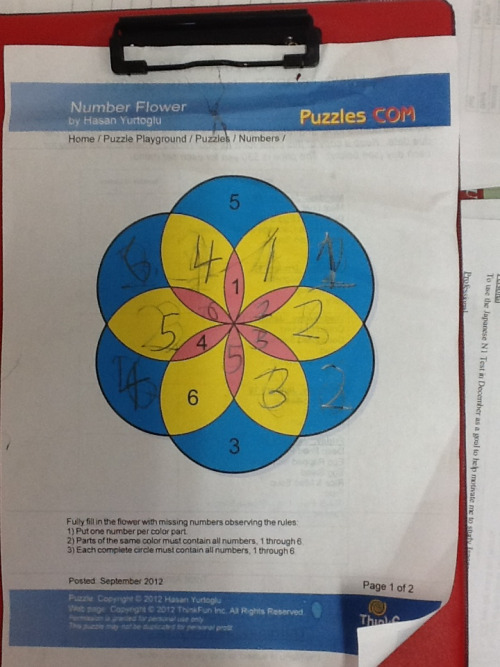
    Number Flower

    It was interesting to watch my class tackle the puzzle below last week.
    I put them into pairs and read the directions to them. Then I let them go off and try it.


    At first they were all very noisy shouting for help and I heard a lot of, "I don't get it". That was all very uncomfortable for me. I want my students to be independent problem solvers, and I don't want to be a crutch.

    Then I gave the class a hint, or reminded them, that you can only use one number once. Suddenly, one student said aloud, "I got it!" and group after group started working on the puzzle.

    I really enjoyed seeing the tension that this puzzle caused my students. I also enjoyed talking to the most vocal  of the "Can't Doers" and asking about her thoughts.

    Sunday, September 23, 2012

    Thinking Time

    I started playing tennis about a year ago. I suppose I should say that I started taking tennis lessons about a year ago.

    Yesterday during the lesson I had a lot on my mind. I was thinking about how I would continue to use my class's interest in the book Mr. Topsy-Turvy. The book is silly, and the students really enjoyed it, so I took it as an opportunity to talk about topsy turvy things. In the process it was great to see the kids really working their brains to turn sentences around the wrong way. (If they know the wrong way, then they won't say it that way my theory goes, but I have mixed feelings about it.)


    I was thinking about the weekend and I was thinking about my tennis game and concentrating on the instruction I was being given. I was thinking about lunch because I was hungry. I had a lot going on in my head.

    Except for when the coach says in his best English, "Drinking time!", the tennis lessons are all in Japanese, so I have to concentrate more than my fellow students. On top of that, they play futsol right next to us.

    Then when we were practicing our serves -- more intense concentration -- the coach told me that he would be leaving at the end of the month, which was rather shocking. In addition, the assistant coach is also leaving, although not together per se. (They wait until the last minute to make announcements in Japan.)

    So after the coach gave his announcement I needed some time to think about them leaving and I had questions like: What would they do from now? Where would they work? But of course I couldn't ask them because they are personal. I was also thinking about the proper response in Japanese. What should I say?

    This all got me thinking more. I started thinking about my own class and how they are all ESL/ELL/EAL learners. All of them.

    This year I have been more conscious of  giving the first and second graders time to think. I hope I am giving them enough. Just because they don't react right away doesn't mean they are not thinking about what we are talking about.

    And now I am wondering what else I can do besides oral answers in English.  Maybe having them draw or write in their own languages might also help [those that need it].

    Wednesday, September 19, 2012

    Can You Make a Sphere From 2-D Shapes?

    This is a question I posed to my class this week.

    Our current unit's central idea is: We are from all over the world. Now we live together in Sendai. I wanted to do more art projects this year with my class (with art being the traditional definition) and I thought that linking Sendai's famous Tanabata Festival to math would be a thought-provoking project for the class.

    Since tanabata decorations are streamers with a ball on top (I thought they were shooting stars, but apparently they are flowers) my idea was to have the students make it all.

    One group started by making circles, having mistaken a circle for a ball, or sphere. But it was a really cool pattern. So I reminded them what the project was again and sent them on their way.


    I went over to the other group (who were protecting their sphere like it was something out of Skunk Works)  where I found them working on good ideas, but they were all working separately. I understand that some  people work better alone, but I want these kids to build their collaboration skills, so I encouraged them to work together.

    I went back to the other group to find that they started using hexagons. Wow, I thought. It is like a soccer ball. Thinking that they were thinking the same thing, I asked why they were using hexagons. Their answer was that they resembled circles. I really liked how they are putting trapezoids together to make hexagons as well as the rhombi. 


    They attempted to roll the hexagon sheet into a ball, but it collapsed on itself.


    I think we will have to use some different materials.


    Just seen on T.V. -
    Doubling the size of a wheel makes it twice as heavy.
    Really? I have to test that property.

    Does 2+4 = 4+2?

    Today we were talking about the many different addends for a certain sum. On the whiteboard I put up ____ + ____ = 6 and I had the students come up with different possibilities.

    I think their answers were along the lines of
    3,3
    4,2
    5,1
    6,0
    2,4

    I looked at the last one and I thought to myself, are 4 and 2, the same as 2 and 4?

    So I posed this problem to the class: Suppose we are looking at our own class were our equation is ___ + ___ = 8. What are the two addends for our own class?

    Again I got answers like:
    4,4
    5,3
    3,5
    7,1
    8,0

    My thought was 3 and 5 since we have three second graders and five second graders. But when I started asking the students about why they thought of those number combinations, I was impressed.

    The boy who said 4,4 was thinking of 4 boys and 4 girls. Someone else said the combination was 8,0 because we were all Grade 1-2 students.

    I was hoping someone would talk about our nationalities, but maybe it is better that did not happen. Nationality can be a sensitive topic.

    After asking some more questions, we found out that we have four 7-year-olds and four 6-year-olds.

    I wish we had more time today. We should look more into these sums.

    Tuesday, July 31, 2012

    Poetry - The Writing Equilizer

    At the end of last year I was scheduled to teach poetry. I was excited to see what my students would do because we had been doing some interpretative dance videos, and they did much better than I had ever expected.

    Here's what I remember doing (it was two long months ago that I did this)
    • I started out by reading some poetry to them.
    • I then put up a keyword to brainstorm around; plants.
    • I then had them brainstorm words associated with that term.
    • I then went through a standard quatrain style, and told them to use it as a framework for their poem.

    There was a boy in my class last year who I know has the ability to perform better than he has, but for the past few years has not. When I passed by his desk to see how he was doing, I was not expecting much.

    When I saw his poem however, I was shocked. It was an awesome poem. When I read it, I could hear a song coming out of it and it had great emotion to it. It was really cool.

    For that kid, poetry was where he was equal to his peers.

    Then I started thinking that maybe instead of writing stories or journal entries, this kid's knack was writing poetry or shorter verse stuff. I am going into new territory this year by switching grades, but I have to remember to incorporate many types of writing in the class to try to not only hit on the students' strengths, but also give them new challenges and creative outlets.

    Here is the first draft of his poem.


    eitetsu-poem