I came across this article on Teach Thought entitled, "Growing Closer To Your Most Challenging Students" and it inspired me. Of course, that was last week.
When I encounter a challenging student, I try to win them over. I do this by trying to get to know them better and building a bond with him or her.
By creating this relationship, more times than not the student will settle down. I usually learn something about him or her. By understanding where the behavior issues are coming from, I have more empathy and am able to handle issues that arise with more compassion.
This is not to say that issues disappear when a relationship is built, but rather that issues are able to be met with more understanding.
Time for recess duty.
Monday, September 1, 2014
Thursday, June 19, 2014
Photography in the Classroom
I first bought a digital camera when I came to Japan in 2003. Since that time I have gotten more serious and have spent a fair amount of money on it.
I have also changed the way I use the pictures I take in the classroom.
I started out taking pictures of the students in action and putting them up around the room or outside of the classroom. I still do that, but I have extended it to taking pictures for other teachers in the school as well as in my own classroom.
I also decided that the one page my students get in the yearbook did not come close to accurately
Monday, June 16, 2014
Continental Draft
A while back at one of our school's PD days I was introduced to a video call Austin's Butterfly Drafts.


Since it was their first time doing this activity, and we did this as a whole class instead of breaking into smaller groups it took a long time. They were all very interested in helping others, however they were not so interested in hearing critiques from other students. I had to keep reminding them that this was for their own benefit.
This video shows the power feedback and how students can improve through the feedback cycle.
We are in how we organize ourselves unit we are studying communities and I found an opportunity for the students to use each others critiques to make their original map better.
The students are reading a book called Me on the Map. We are making a flip book based on Me on the Map that starts as continent and moves to country, city, street, house and down through the layers to the students own bedroom.
Yesterday I had students draw a picture of Asia. I did project an image of it and passed out some iPads so that they could have the image to look at while they drew.
Some students surprisingly could do a really good job, and others were rather lazy with their drawings and could clearly improve.
Some students surprisingly could do a really good job, and others were rather lazy with their drawings and could clearly improve.
Today I showed the kids the video about Austin and we talked about how they could improve their own work. Students were very interested to try it out.
Since it was their first time doing this activity, and we did this as a whole class instead of breaking into smaller groups it took a long time. They were all very interested in helping others, however they were not so interested in hearing critiques from other students. I had to keep reminding them that this was for their own benefit.
However when it came time for the students to do their second draft of Asia, they were much, much better.
This lesson took more than an hour, however it was well worth the time. I'm hoping that this lesson will help them think about how they draw their subsequent drafts, and maybe it will seep into how they think about all their work. We will have to do this more often though so it becomes engrained into their thinking.
There was one boy who I actually think did not do as well the second time. That might be because his first draft was so good.
There was one boy who I actually think did not do as well the second time. That might be because his first draft was so good.
Understanding by Design - Chapter 3
Standards and Big Ideas
Standards provide teachers with a "focus" for which they teach.
Big Ideas from Lynn Erickson (2001)
Wiggins and McTigue go on talking about how Ercikson's list of big ideas can be generalized (p. 69)
Standards provide teachers with a "focus" for which they teach.
Big Ideas from Lynn Erickson (2001)
- Broad and abstract
- Represented by one or two words
- Universal in application
- Timeless--carry through the ages
- Represented by different examples that share common attributes (Erickson 2001 p. 35)
Wiggins and McTigue go on talking about how Ercikson's list of big ideas can be generalized (p. 69)
- Providing a focusing conceptual lens for any study
- Providing breadth of meaning by connecting and organizing many facts, skills, and experiences; serving as the linchpin of understanding
- Pointing to ideas at the heart of expert understanding of a subject
- Requiring "uncoverage" because its meaning or value is rarely obvious to the learner, is counterintuitive or prone to misunderstanding
- Having great transfer value; applying to many other inquiries and issues over time--"horizontally" (across subjects) and "vertically" (through the years in later courses) in the curriculum and out of school
Thursday, June 12, 2014
SECRUOSER - A Natural Resources Adventure Role Play
Our Planet Earth
The decisions we make can affect the planet.
2. Current environmental issues in Japan and the world.
3. Responsible decision making: exploring the difference that we can make.
When I saw natural resources, my thoughts drifted back to my first year working at TIS. At that time I was teaching PE, and I would drift in and out of classrooms when I could, and I remember very clearly seeing a bulletin board with trees on it, then a few weeks later the trees were cut in half. When I asked about it, the Grade 3-4 teacher told me they were learning about resources and he used that as a kind of role play.
Fast forward to this year and I was faced with a natural resources unit, so I decided to give it a shot.
 |
| The yellow boxes show where the students wanted to build houses. |
I first set the landscape. I created an area modeled after Miyagi, Japan (where we are). I first talked with the students about the different features of the landscape. We talked about the trees, the water, the animals, and the mountains and the possibility of minerals in them (thanks to Minecraft). I told them that the name of the land was SECRUOSER. I intentionally wrote it next to the word resources to see if anyone would get it, and one astute student did. Now I wish I had left that nugget for later.
Next I had the students scout out their homestead. They each came up to the board and pointed to where they wanted their house. Several students placed their homes close to each other in the upper part of the board.
Surprisingly only one student chose a place on the lake shore. They don't know what they are missing.
 |
| An explanation about the placement of a house. |
Many students chose to build away from the coast of the ocean and away from water as well citing tsunamis. Other students talked about floods and introduced words like "avalanche" and "landslide". Natural disasters were a huge influence on their decisions.
I wonder if this is because of Japan, the March 11, 2011 earthquake, or if it is just their age.
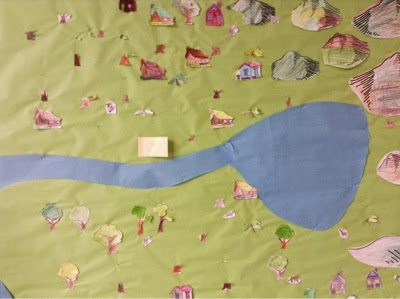 |
| SECRUOSER after the purge. |
I then found some house cutouts. I showed the students each one and assigned them a tree value. There was a grass house that cost one tree, a stone house that cost one tree, a few that cost two, and one that cost three.
 |
| All trees and houses for this board were made using scrap paper. |
Each time I put up a house, I cut that many trees from the board, but I left stumps so they could see what was happening. This is what caught their attention. When I cut the first tree there was a silence in the room that told me the shock helped them realize that the decisions they had made had consequences that they could not get out of.
I went to all the students collecting houses, and when I did, I asked the class how much the house cost. I then told them that if you were to build a house, and had no vehicle, you would cut the trees closest to where you lived.
The boys who moved next to each other found that when humans get together there will be a large hole in the forest. In our land area the whole forest north of the river was ravaged. The students who chose stone houses saw parts of mountains taken out.
One student was so excited he brought his mom into the room and told her all about what happened.
Next chapter: What happens to the animals? OR When beavers strike.
Subscribe to:
Posts (Atom)