Thursday, February 13, 2020

Another Round of Apple Teacher - "Oh! This is what I want to know."


Last year I was approached to help teachers learn how to use their new Macbooks. I had led some teachers through the Apple Teacher program at my previous school and it was pretty successful, so I thought trying it again here would be a good idea.

Last year did not work out, so we tried again this year. With the interested teachers signed up and all the surveys sent, we had our meeting day. Then, three teachers showed up. Well, two is better than none.

Here are a few reflections from trying Apple Teacher at this school.


These are not the Tech Ambassadors

At my last school, the Tech Ambassadors were teachers who were selected to join the program based on what division in the school they taught in and their tech skills. I based my prediction that they would finish this training in an hour on that last cohort.


Get Your Apple ID!

If teachers have their IDs on hand (with passwords) things will go smoother. Unfortunately, not all did. No problem, if you do not remember your ID, you can "easily" create a new one.


Taiwan is not an Apple Teacher Country

Just be careful if you are in Taiwan. I am sure there are other countries, but one teacher is from Taiwan so put that as her home. Apple does not recognize Taiwan in the application form so she ran into problems signing up.


"Oh my gosh. Look at this!"

It was great to hear and see teachers learning how to use their hardware and software better. One reason I told them to take the course is to learn how to better integrate the Apple products into their teaching. Or if not Apple - do something similar with Google or Microsoft, etc. Use online courses as a way to learn new ways of teaching (or find what you don't like in them).


Time and Space

I think the best reason to get teachers together is to give them time and space to work on what they are interested in. Like one teacher said, "If I could come into your room during lunch, I would work on this."

OK, you are welcome anytime.

Monday, January 27, 2020

A Lesson in Color Mixing

Our school doesn't have a dedicated art teacher. In my 2.5 years here so far, I have incorporated a fair amount of art into my lessons, but I often use it as an add on to the lesson rather than the focus. This year, we are in the second year of the two-year cycle (or is it the first year? It's the second for me.) and we have a unit that is specifically about the elements of art.

Today my class learned about paint mixing.

I was imagining students would have these little pieces of work that showed mixing. Ideally, I wanted to see some sort of a color swatch.

Usually, I create a model for students the day before, but I didn't have a chance this time. So I thought I could do it the day of the lesson - again, I was foiled.
What I assumed some student work would look like.

When I was presenting to the students, I showed them a color swatch. I can't show it here because it is a copyrighted image, but it was one that had the colors lined up in columns.

Photo by Copper and Wild on Unsplash


A post shared by Thomas Hammerlund (@thomashammerlund) on


The student work wasn't terrible, but it could have been better. Next time I would do a few things differently.


Student work


Warn About Mixing Dark Colors First

This is something I had been warned about before starting, so I was about to warn my students about it before we started. If I were to do this again, I would emphasize it more.


Mixing with Sticks

The popsicle sticks should stay with the colors!

I only gave the students a very little paint at first and they each got a popsicle stick. That was good. But, I forgot to remind them to just keep a stick in color.

I did tell them that they would need to mix their paints in the paint cups and most did that. You can tell when they don't by the amount of pain on the paper.

The class layout and the colors at each table


Focus More on Ratios

The ratio portion of this lesson was quick. If I were to do this again, I would go more in-depth into ratios.

One way to do this might be to have them use the site Try Colors. This site could show students the effect of adding more of one color.

====


Just in case the Instagram post is ever deleted. (That's happened to me before.)

Sunday, October 6, 2019

Starting the Inquiry with Background Knowledge


Patrick Tomasso

I was listening to the Principal Center Podcast and the guest was talking about reading comprehension and how students need background knowledge.

Cool. I can give students more background knowledge, I thought.


Then today I was attending a PYP Workshop on assessment and the ATLs. We did an activity on the skill [ATL] of observation. We observed raisins moving up and down in a glass of 7-Up.

The words and concepts we were using (ie, surface tension, carbon dioxide, buoyancy, floating, sinking, absorbing, etc.) would be really challenging/impossible for an EAL student to come up with or describe.

This had me thinking about the next unit and how I could incorporate more background knowledge.

I thought back to a strategy I heard from a now-defunct podcast where you give all students an article and tell them to come up with one question. Then have the students make categories out of the questions.


From there the students do research.

My plan for the Tuning In phase of the next unit is to do the above in a few periods and present their findings. From there I will build on what they find and address any misunderstandings.

That's the plan until it changes.

This may be an obvious thing, and I used to do this, but somehow I got out of the practice. Somewhere along the line ...

Tuesday, September 24, 2019

"The Fall" a Small Moment Example


We are inquiring into small moment stories now in the writer's workshop, and it just so happens that something happened to me that is a small moment. So I wrote about it.

Click the above image to access the book.

Tuesday, June 4, 2019

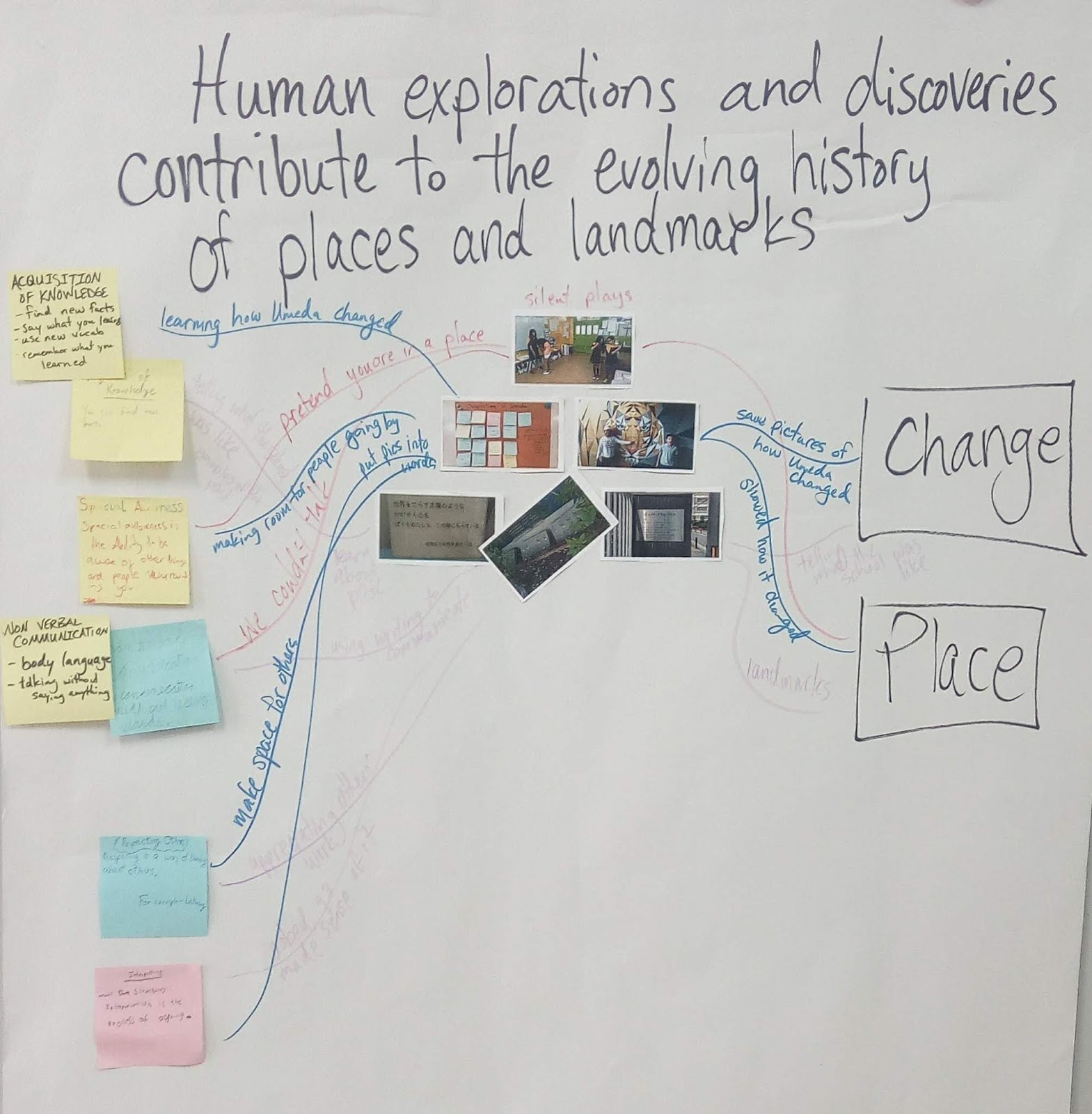
Building Understanding of how it all Fits Together


On the top is the unit's central idea. 
On the left are the skills we are focusing on. 
On the right, the unit concepts.
In the middle are the activities we have done (at this point in the unit we have done three).
As we do activities, we have discussions about how the activities are or aren't related to the skills and concepts we are focusing on.