Showing posts with label Knowledge Constructor. Show all posts

Tuesday, October 4, 2022

Flipping Groupings

Having students work in groups is something that happens in all classrooms. Many teachers will give students roles to help focus their work. 

Recently I have seen a new kind of role enter the groupings - where teachers have students take on the role of a scientist, an economist, an environmental activist, it could be any sort of job, with the intent of having students use a different perspective when looking at a problem.

For example, I am calling a group that is formed by many roles a team, when the same roles come together, I am calling that a group. I hope I can keep them straight.

In the following team, the roles are artist, scientist, and journalist. This team would work together to solve the problem presented to them. 

Role Name
Artist Maria Anders
Scientist Alfreds Futterkiste
Journalist John Smith
 

However, instead of starting with the groups, start with grouping the roles. Put all scientists [insert role here] together. They will then research and build knowledge together. After a period of time, form groups. 

This would allow them to build and share knowledge which they could then bring back to their team.

This idea came to me when supporting an MYP Physics class and I made a connection to some research I have come across that stresses that content knowledge is a bigger factor in comprehension than reading skills.

Sunday, October 6, 2019

Starting the Inquiry with Background Knowledge


Patrick Tomasso

I was listening to the Principal Center Podcast and the guest was talking about reading comprehension and how students need background knowledge.

Cool. I can give students more background knowledge, I thought.


Then today I was attending a PYP Workshop on assessment and the ATLs. We did an activity on the skill [ATL] of observation. We observed raisins moving up and down in a glass of 7-Up.

The words and concepts we were using (ie, surface tension, carbon dioxide, buoyancy, floating, sinking, absorbing, etc.) would be really challenging/impossible for an EAL student to come up with or describe.

This had me thinking about the next unit and how I could incorporate more background knowledge.

I thought back to a strategy I heard from a now-defunct podcast where you give all students an article and tell them to come up with one question. Then have the students make categories out of the questions.


From there the students do research.

My plan for the Tuning In phase of the next unit is to do the above in a few periods and present their findings. From there I will build on what they find and address any misunderstandings.

That's the plan until it changes.

This may be an obvious thing, and I used to do this, but somehow I got out of the practice. Somewhere along the line ...

Tuesday, June 4, 2019

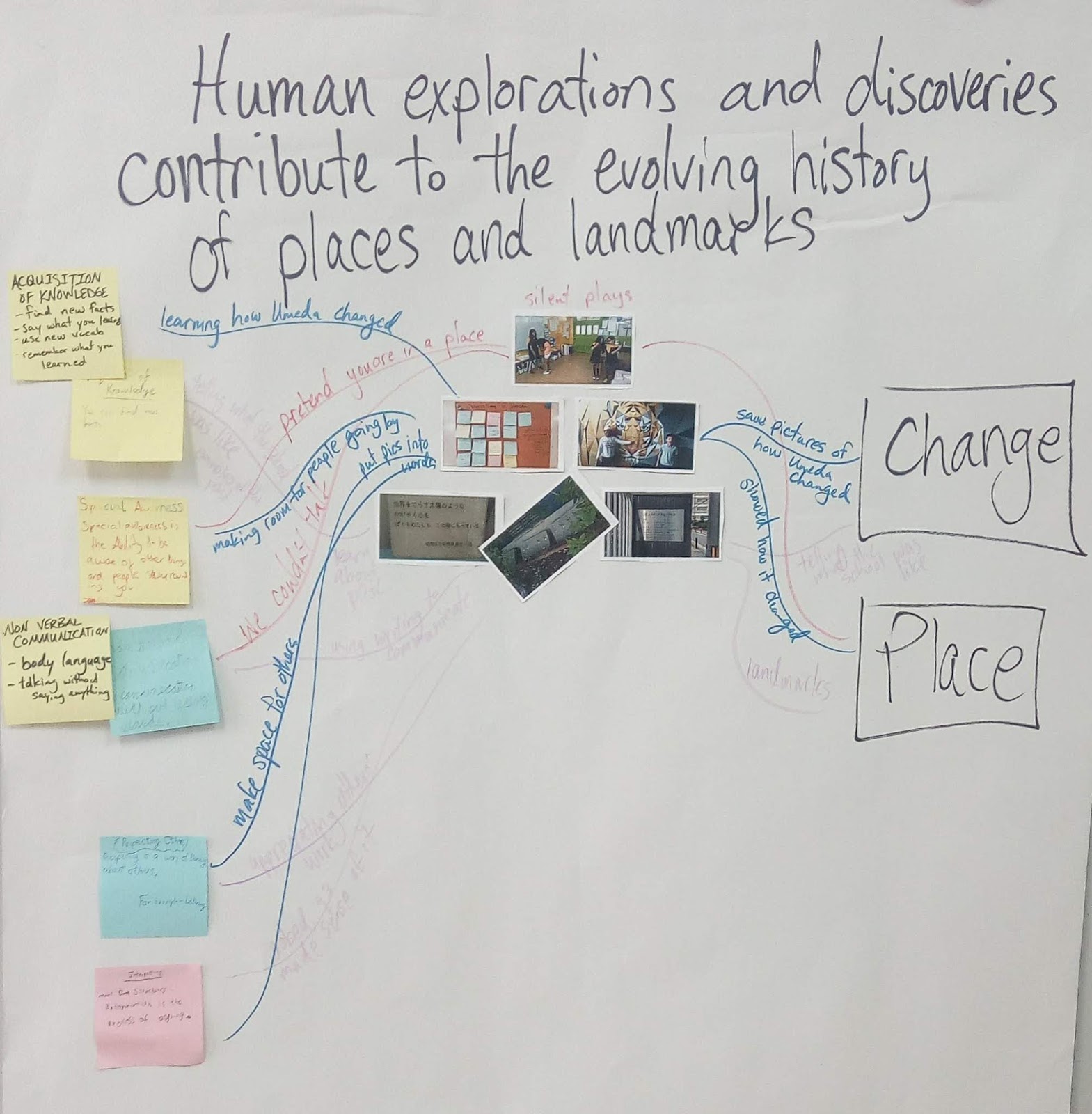
Building Understanding of how it all Fits Together


On the top is the unit's central idea. 
On the left are the skills we are focusing on. 
On the right, the unit concepts.
In the middle are the activities we have done (at this point in the unit we have done three).
As we do activities, we have discussions about how the activities are or aren't related to the skills and concepts we are focusing on.

Saturday, July 23, 2016

Creating Norms


What roles will you take when coaching? 
What roles and responsibilities will the peers you collaborate with assume?


Review the list of example norms below.  

Norms
Creating norms for a group, even groups as small as two participants, establishes a set of ground rules to help teams work together more efficiently. When establishing norms, consider the following key categories:
  • Time
  • Decision making
  • Listening
  • Participation
  • Confidentiality
  • Expectations - (Delehant and von Frank, 2007)

Sample Norms
  • Begin and end on time
  • Stay on agenda
  • Reach decisions by consensus
  • Listen respectfully
  • Observe basic conversational courtesies
  • Listen attentively
  • Attend all meetings
  • Discuss issues, not people
  • Honor confidentiality
  • Silence all cell phones
  • Respect questions
  • Monitor your own airtime
  • Do assignments prior to meetings
  • Hold yourself personally accountable
  • Respect the group
  • Attend to goals and objectives
  • Limit distractions
  • Probe ideas, do not criticize people
  • Show respect for views of others
  • Avoid side conversations
  • Assume positive intentions

  1. As you review them address this question: How would adopting this norm help us work most effectively as a team?

Time - Keeping meetings tight (starting and finishing on a set time) is important because teachers are limited in the time they have. There is so much to do with grading, preparing, and duties that teachers will not willingly attend another meeting that wastes their time.


Decision making - Small group meetings could rotate the facilitator responsibility to a different member each session. Coaching meetings could be run by the teacher, with the coach mostly following. This could give everyone a chance at leading a meeting, allowing for all to feel more involved.


Listening - Listening well to the person who is speaking, makes him/her feel important. Listening is a sign of respect to all members of the meeting they are respected. Along those lines, listening attentively also signals you are able to learn from your colleagues.


Participation - "Showing up is 80 percent of life."Everyone's voice and opinions are important. You never know where the next bit of inspiration will come from. This builds on the last norm, but if you have a culture of listening and showing respect to others, people will be more willing to participate. It is important to get everyone participating so all feel equally involved.


Confidentiality - Secrets, mistakes, and private thoughts and opinions are just a few of the things we entrust our colleagues to keep to themselves. Someone who can keep your secrets safe will most likely be someone you can trust.


  1. Decide on the five or six norms that will guide the behavior of your Peer Coaching community.
I was imagining a 1-1 coaching situation, as was the majority of my experience from last year. Of the options above, the following four were most likely to apply.
  1. Begin and end on time 
  2. Stay on agenda
  3. Listen attentively
  4. Respect questions
  5. Accept ownership for your own learning

  1. If you have not already included it you may want to add this norm: "Accept ownership for your own learning." The goal of this norm is to encourage all participants take responsibility for their learning. It helps each participant in the team to develop their capacity to improve teaching and learning.


Wednesday, July 13, 2016

Roles and Trust in Coaching

What roles will you take when coaching? 
    • Facilitator- Planning and leading meetings, activities, and staff development in one-on-one, small group, or large group situations.
    • Collaborator- Working together with colleagues to plan, implement, and evaluate activities.
    • Expert - Acting as a subject matter expert on a variety of topics.
    • Catalyst - Helping teachers reflect on and improve their practice by using questions strategies and skills that assist colleagues to become effective instructional decision makers. 

What other roles might you take on as a coach?
Innovator -
Very quickly I found myself helping to create a coaching plan and an idea for peer mentoring, as well as helping teachers integrate new tools into their lessons. Many of these happen on a school-wide scale that includes PD. The coach connects teachers in the building to new ideas.


Sounding Board -
Teachers often came to me with ideas they had. Many times it was just to talk and flesh out their plans -- not all of which came to fruition right away, and many needed more time. There were some good ideas that couldn't happen last year, but will form a starting point for this year.

Sometimes teachers would talk to me about personal issues when there was seemingly no one else around. I think that shows how important it is for coaches to be non-judgemental. That stance builds trust.


Caffeine -
I don't really know what to call this on, but I found the coaching role help teachers feel more comfortable to try to implement tech on their own -- even when I was not in the room with them. Teachers seemed more confident having someone in the school who they knew they could count on. This is only referring to technology, and I need to say that we have an awesome technology department. Knowing that someone would be available probably helped give teachers the confidence to try to push their own practice [possibly. this is speculation].


Why is trust-building important in coaching?

  • Why is trust critical to coaches?
Most teachers won't move out of their comfort zone and try new ideas if they feel they are being judged. Innovation / moving forward happens in a safe, non-judgemental environment. Coaches play an especially important role in that they work with teachers to create new lessons. Working with someone who is non-judgemental allows you to free your inhibitions and have the confidence to work with the unknown.

  • What can coaches do to engender trust? 
As I thought about this answer, I kept coming back to the safety of information. Coaches can engender trust by demonstrating to teachers that the information shared with them will not be shared with others. Once teachers know [negative] information will not be spread by a coach, it is easier to trust and work with them.


Wednesday, July 6, 2016

What roles and responsibilities do peer coaches assume?

Part A: Coach Attributes 


The characteristics or qualities a coach brings to the job are critical to a coach’s success and will shape the roles a coach plays.
  1. Jot down your ideas on the qualities that would be desirable for a coach to possess.  You may also want to ask a peer to define a few desirable coach qualities.
  • positive / approachable
    • You will not ask someone for help whom you don't like or trust (I suppose trustworthy should be another characteristic), so a good coach should be approachable. When I think of the people I approach for advice, one commonality they all have is that they are positive people and creative problem solvers. (I suppose I could have added curious, or problem solver to this list as well).

  • risk taker - willing to try new ideas
    • A coach will encounter a wide range of lesson ideas -- not all will be in one's comfort zone. Teachers want to work with someone who is willing to try their ideas as well as give them ideas.

  • knowledgeable of tools as well as pedagogy
    • A coach will be up to date on the best tools for the job, and be aware of new tools that could be used. More than the technology, however, student learning should take precedent. A good coach will know this and always place student learning at the forefront.

  • patient
    • Another characteristic of a coach is patience. A coach understands that plans do not always turn out as expected. Coaches should be able to adjust as needed.
    • The skills and experience integrating technology can vary greatly between teachers. Coaches require patience with those who need it.

  • proactive
    • Coaches seek out ways to help others by making observations and offering suggestions. Often this will be without being asked. This can be in the form of looking at the curriculum map and gathering resources and ideas ahead of time.

  • good listener
    • Coaches are good listeners. 

===

  1. Review the qualities teachers who collaborated with coaches say strong coaches should possess.  Teachers say a successful peer coach:
    • Is able to build trust with peers.
    • Builds on what a teacher needs.
    • Is a team player.
    • Communicates well and listens to teachers.
    • Knows what teachers are doing in their classrooms.
    • Can show teachers how to replace what they are doing with something better, not just present technology as an add-on.
    • Is highly organized and plans well in advance with teachers.
    • Provides a safe, risk-taking environment and is non-threatening, non-judgmental, and accepting.
    • Is flexible.
    • Has enough depth and breadth of knowledge to help teachers who are at various stages of technology integration, including knowledge of appropriate instructional strategies.
    • Knows how to organize and structure a technology-rich classroom.
    • Is recognized by staff as a strong/outstanding teacher.

  1. After reviewing your list, and the ideas of coaches’ collaborating teachers identify one or two most important qualities of a strong coach.
    1. Communicates well and listens to teachers
    2. Knows what teachers are doing in their classrooms
  2. Keep your list of attributes handy as you define your roles as a coach and develop your coaching plan.


Monday, April 25, 2016

Great by Choice: Chapter 1

It's always possible to go from good to great. (p. 8)


Not a lot happened in this chapter, but there were several previews of myths the researchers dispelled.

  • Successful leaders are bold, risk-seeking visionaries.
  • Innovation distinguishes successful companies.
  • You're either quick or you're dead.
  • Radical change on the outside means radical change on the inside.
  • Success means you had a lot of good luck.

So what does this mean for educators?

Combining "creativity with discipline" (p. 10) would allow for someone to succeed - and more. Creativity seems to be the key.

Enough rambling.