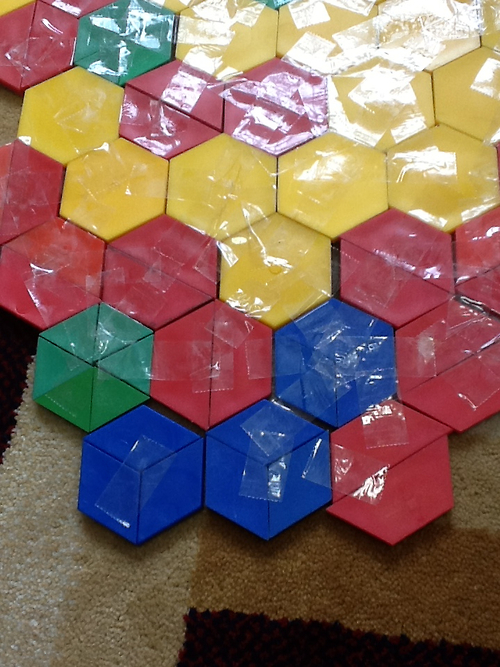
A dual-level classroom is an interesting environment to teach in.
Every year the students I had the year before amaze me when I compare them to the new students coming in. I just started teaching the grade 1-2 class last year, so I didn't see it, but I have been happily surprised at how much the second graders can do by themselves.
The high of seeing what the second graders can do is seeming to distort my perception of them.
I have to constantly remind myself to see them for what they can do, and not what they cannot do.
This summer I had a list of things I wanted to do with my class this year. And we will get to that list, but it will not come right away. It is hard not to fall into the trap of rushing them, pushing them too fast, trying to get too much done. It is a hard thing not to do.
So I wrote myself a reminder and hung above my door, "Enjoy the Process".
Tuesday, August 27, 2013
Saturday, July 27, 2013
Volunteering at the Neighborhood Festival
| The beginning of the festival in a gym - this would be backed before long |
I got there and went to my area's booth (the cotton candy and popcorn booth) at 2:30 just in case there was anything I could help out with, but they said there wasn't anything and to come back at 3:30. When I came back (on time this time) I talked to a guy at our booth who looked like he was in charge. He showed me around and had me practice making cotton candy a few times. Making cotton candy is harder than it looks. I bombed both times I tried and the guy asked me if I would rather help get the cups of sugar ready to pour into the machine. That I could do.
There I was scooping sugar in front of a wall of people while Gwen Stefani's "Hollaback Girl" and the odd mix of pop and rap when I got the call to step up and relieve someone making cotton candy. This time went better and for the next few hours I alternated between pouring sugar and making cotton candy with a mix of Western music and Japanese cultural dances.
Everyone at the booth was very friendly and it was a good way to get to know some of the people living in my neighborhood.
Unfortunately the fireworks were cancelled due to rain.
Thursday, July 25, 2013
Teacher Tours of Duty
I have seen the term "teacher entrepreneurs" around on the Internet, but I never looked into what it meant assuming it was referring to teachers who make extra selling lessons or possibly those who facilitate teacher training.
Today I was listening to The Harvard Business Review's podcast (ideacast) and they had two authors on the show who wrote an article for hbr.org called, Tours of Duty: The New Employer-Employee Compact.
This article is all about how the landscape of business has changed and how the relationship between employee and employer has entered a mutually-beneficial compact where the employee goes to work and builds their own skill set while helping the company prosper. In this scenario, it is expected that employees are "free-agents" and will leave for a better job and the employer should encourage it to maintain flexibility.
While I was reading this I could not help thinking of how similar this is to the international school culture. After all, we are on contracts that last as little as one year. Teachers are generally on the lookout for more professional development. Schools generally encourage [and pay for] it, and they benefit from the connections teachers make to other teachers through the knowledge gained from those connections.
So, if we teachers want to help the schools we work for, one way to do that is by growing our personal learning networks (PLNs) to tap the ideas and knowledge of the teachers outside our schools.
If you teach at an international school, this might be an interesting listen (if nothing else than marveling at how the rest of the world is caching up to international schools.)
![]() |
| No connection to the post - I just wanted to add some color here. |
Wednesday, July 10, 2013
Goals and Motivation
I started playing tennis a few years ago. It came about as a perfect storm of influences came together at the same time: my wife was playing, we wanted something to do together, and my futsal club fizzled. (I really wanted to continue playing futsal.)
So I started taking tennis lessons on Saturdays. I did this for a while and I saw mild improvement in my game.
I switched tennis schools last fall and happened to be put into a class where I was the only student. This allowed for not only personalized instruction, but I also got to play against the coach.
Playing against him was a lot of fun and helped me see [the many] flaws in my game. Which in turn got me thinking how I wanted to get better, so naturally I decided that I needed to play for more than one hour a week.
Knowing that I liked actually playing tennis matches, but not know what else to do, one day I told my coach I was interested in joining some tournaments in the region and asked him if he knew of any I could join.
From that day, even though I know I am not very good and entering a tournament would be futile, I have become much better.
Why?
One reason is that I went from playing one hour a week to playing 6-8 hours a week. Anyone who did that would get better.
I think though it is because I set a goal for myself. I told that goal to someone who is watching me and who can help me achieve that goal which in turn increased my motivation.
I am not a goal setter myself, but maybe when I do set a goal for myself I am doing it wrong.
I have been thinking about goals, motivation, and tennis this through the summer and I have been trying to wrap my head around increasing motivation for my students. First and second graders love to learn, but I want to know how I can get a student who shies away from reading to like reading - or writing. How can I get my students to care more?
20% time is something I have wanted to start in my own classroom. Last year I thought about it, but I don't know what it would look like so I didn't implement it. Yesterday I was mapping out my weekly schedule and looking at my units for the year, and I calculated 20% of the week and was getting ready for the new school year.
This morning as I was starting to write this I came across a post on Google Plus by +Vicki Davis about a MOOC about 20% time. It started last week, and I don't like joining late, but I joined.
Now I need to motivate myself through this heat and humidity.
So I started taking tennis lessons on Saturdays. I did this for a while and I saw mild improvement in my game.
I switched tennis schools last fall and happened to be put into a class where I was the only student. This allowed for not only personalized instruction, but I also got to play against the coach.
Side note: For some reason three of three tennis schools I have been to do not have beginners play games. A topic for another blog post is how playing games shows the students why the coaches have the students play a certain way. Without playing the game, the drills and instruction have no meaning. Once you play a game, you can see why the coaches have you do certain things.
Playing against him was a lot of fun and helped me see [the many] flaws in my game. Which in turn got me thinking how I wanted to get better, so naturally I decided that I needed to play for more than one hour a week.Knowing that I liked actually playing tennis matches, but not know what else to do, one day I told my coach I was interested in joining some tournaments in the region and asked him if he knew of any I could join.
From that day, even though I know I am not very good and entering a tournament would be futile, I have become much better.
Why?
One reason is that I went from playing one hour a week to playing 6-8 hours a week. Anyone who did that would get better.
I think though it is because I set a goal for myself. I told that goal to someone who is watching me and who can help me achieve that goal which in turn increased my motivation.
I am not a goal setter myself, but maybe when I do set a goal for myself I am doing it wrong.
I have been thinking about goals, motivation, and tennis this through the summer and I have been trying to wrap my head around increasing motivation for my students. First and second graders love to learn, but I want to know how I can get a student who shies away from reading to like reading - or writing. How can I get my students to care more?
20% time is something I have wanted to start in my own classroom. Last year I thought about it, but I don't know what it would look like so I didn't implement it. Yesterday I was mapping out my weekly schedule and looking at my units for the year, and I calculated 20% of the week and was getting ready for the new school year.
Now I need to motivate myself through this heat and humidity.
Saturday, June 29, 2013
Taking the Time to Blog
Since winter break I have struggled to post to my blog. The words did not flow from me and felt forced; as a result blogging and ultimately reflecting felt like a chore.
I think that I was simply out of practice. As I allowed other tasks to fill the time I had been using to reflect, I fell more and more out of my rhythm and each subsequent post became less and less frequent. The downward spiral had begun.
I was still really good at coming up with ideas to blog about and I saved them as a draft post. Right now I have 45 ready to be completed. I hope I can remember what I wanted to say.
When the new school year starts in August and I find out what my schedule is, the first thing I am going to do is to take one period a week and block it off. I am going to use that period for reflection and writing.
Subscribe to:
Posts (Atom)