Monday, December 10, 2012
What My Blog Says
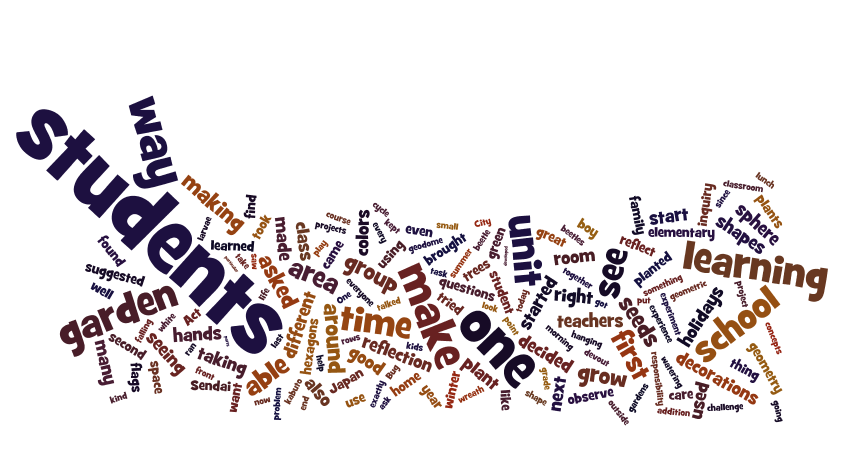
In response to the post @whatedsaid made, I decided to create a Wordle showing what my blog says.
I am glad to see the most common word is students since this is a reflective blog after all.
Sunday, December 9, 2012
International Mindedness in the Holiday Season
| Sendai, Japan in the winter |
I began thinking about this post topic today while reading the section about perception in Engaging Minds. I was particularly moved when the authors talked about how a participant in the research study brought to attention Christian symbols in the school. (p. 53) They talked about how we can sometimes dismiss these claims as not getting into the spirit. But it is really?
The winter holidays here in Japan look a lot like they do in the U.S. There are decorations all around, people are out and about shopping, and there are lights put up all over the place. Every year our school does some caroling with traditional and non-traditional songs. They are even sung in different languages. It can make one feel as if everyone is on the same wave length about what it all means.
My class is currently in the middle of learning about Fairy Tales, and for part of this unit I want the kids to practice acting and performing. So, before the unit started I decided to use some cardboard tubes to make a forest.
I had some 3D shapes hanging in my room from the last inquiry about geometry, and wondering what to do with them, the trees, the holidays and the shapes came together - I decided to make one of the trees into the shape of an evergreen and hang the shapes from it.
I made it, taped it to the wall, and hung the decorations one evening after all the students had gone home so the next morning they came in and were excited. This brought up all sorts of connections they had to the holidays - about what they do in the holidays, the decorations they have in their houses, and their own trees.
This is when I looked at one boy right in front of me. This boy is a from a devout Muslim family. So devout in fact, that a few weeks prior had to cancel school lunch for a day because it contained pork. (That's when I learned why he usually brings a lunch from home.) He is also a textbook TCK (Third Culture Kid) with parents from different countries and the family living in a third.
Realizing he probably does not have a tree at home, I asked him what his family does around this time. Do they have any decorations?
He said they have a wreath.
That was perfect I thought. It was a way we could use the hands we had made in our unit on culture. The kids traced their hands on paper the color of the flags where they are from. We used the hands to make a wreath that we are hanging in the front of the room.
Realizing he probably does not have a tree at home, I asked him what his family does around this time. Do they have any decorations?
He said they have a wreath.
That was perfect I thought. It was a way we could use the hands we had made in our unit on culture. The kids traced their hands on paper the color of the flags where they are from. We used the hands to make a wreath that we are hanging in the front of the room.
- This brought up a good observation from the same boy referred to above about how all the colors of the hands we made have the colors red, white, and blue even though the students took colors from many different flags. (It also gave me an idea to do a graph of the colors in the worlds flags since we are studying graphing in Math now.
Thursday, December 6, 2012
Planting the Seeds
One thing I want to do more of is cross-unit projects. I would like to start a project in one unit, and be able to use the same thing for further learning in the next unit.
Act 1
Way back in September I had my students try something I knew way way over their heads, but I wanted to see how they would tackle a challenge. I asked them to make a sphere with these geometric shapes I have.
All in all they did a good job. After all, they are only in first and second grade.
The first group was generally in going in the right direction by making a box-type thing. Their problem was that it was too heavy and kept falling in on itself.
The second group started making their sphere using hexagons using the theory that the hexagons were close to circles. (I was hoping they picked them because soccer balls have hexagons on them.)
This group ran into the same sides-were-too-heavy problem that the first group I described ran into, but they got to that point faster than the other group. At this point I asked them what was wrong - the sphere keeps falling down. So I asked them what would help them. they didn't know so I suggested toothpicks.
As I was talking to my coworker about what was going on in my classroom, he suggested making a geodome with newspaper rolls.
My next math unit became geometry.
Act 2
From the seeds of the sphere challenge came a grander project. In our geometry unit, one of the projects of inquiry was to make the geodome. We were able to measure, find out that a triangle is indeed the strongest shape, collaborate, and accomplish something.
Act 3
After that was finished I had this huge structure in my room. One student suggested to make a house, but today, it was used as a prop in our play The Three Little Pigs.
Not exactly the type of connection I am looking to make, but it was good to have.
Act 1
Way back in September I had my students try something I knew way way over their heads, but I wanted to see how they would tackle a challenge. I asked them to make a sphere with these geometric shapes I have.
All in all they did a good job. After all, they are only in first and second grade.
The first group was generally in going in the right direction by making a box-type thing. Their problem was that it was too heavy and kept falling in on itself.
The second group started making their sphere using hexagons using the theory that the hexagons were close to circles. (I was hoping they picked them because soccer balls have hexagons on them.)
This group ran into the same sides-were-too-heavy problem that the first group I described ran into, but they got to that point faster than the other group. At this point I asked them what was wrong - the sphere keeps falling down. So I asked them what would help them. they didn't know so I suggested toothpicks.
As I was talking to my coworker about what was going on in my classroom, he suggested making a geodome with newspaper rolls.
My next math unit became geometry.
Act 2
From the seeds of the sphere challenge came a grander project. In our geometry unit, one of the projects of inquiry was to make the geodome. We were able to measure, find out that a triangle is indeed the strongest shape, collaborate, and accomplish something.
Act 3
After that was finished I had this huge structure in my room. One student suggested to make a house, but today, it was used as a prop in our play The Three Little Pigs.
Not exactly the type of connection I am looking to make, but it was good to have.
Labels:
math,
units of inquiry
Friday, November 30, 2012
Outdoor Learning Space
Tohoku International School, located in Sendai, Japan, has a small student population. As with every good school, we are constantly working to make learning meaningful and exciting for our students. Last year teachers on the elementary team got together and made plans for a way to utilize the space behind our school that was not being used. It was decided we would make five small gardens, one for each class in elementary and one for the secondary students, plus a physical activity space and a shaded area. A few teachers, Mr. Dwyer and Ms. Risker, had experience with gardening and they shared their knowledge with everyone else to get us started.
The older elementary students were given the task of planning how we would layout the gardens. This was a great way to incorporate the geometric concepts of area, perimeter, and measurement authentically. Students also learned about the environment. They were able to observe how plants start as seeds and how they grow. Over the course of the summer and into the autumn, they could see the plant develop seeds and then see the end of the life cycle. For me, the most impressive learning that happened was the sense of responsibility that was developed. Some students took it upon themselves to start taking care of the garden: including the watering and weeding. It was exactly the characteristics that we, as a school, are trying to instill into our students.
The garden has not only been a learning experience for the students, but I found myself learning along the way as well. As we were preparing the soil, one student found a large white larvae in the scoop of dirt. I asked around to see what it was until one of the maintenance men told me that it was a kabuto mushi … or maybe a different kind of beetle. The only way we could find out what kind of beetles they were was by keeping them in our room and taking care of them. Then with the help of my class, I had to find out how to take care of them. My own class was not the only one involved with this, all classes were able to come in and observe them, touch them, and ask questions about them. I had students and teachers bring in materials about beetles in both Japanese and English so we could talk about them and see if what we read matched what we were seeing; to see if what we were doing was the right was to raise them.
As with all great inquiry experiences, the garden allowed us to question - What should the design of the garden look like? Which way should the rows go? What should we plant?, What will grow in Sendai?, think - How will the rows affect the way the plants grow? What would the best seeds be to plant?, discover - When making the garden we found dozens of kabuto beetle larvae that we kept in an aquarium in the classroom, and investigate - The students were able to experiment with how they planted seeds and were able to see the fruits of their labor.
Not only is the garden a great addition to our school curriculum, we also used the opportunity to center our summer school program around the garden. The green area has since expanded to include Bug City, an area that we have set aside to grow free to attract insects (which we call microbeasts). Bug City has in turn taken on a life all its own and has attracted so many bugs that it is now attracting birds and we have now a mini ecosystem in addition to the garden areas.
We have just planted the second round of crops. This time we planted a winter vegetable, daikon, or Asian radishes, and the learning cycle has started again. For many of us, it is the first time we are seeing diakon sprout and start to grow and new questions are emerging. I cannot wait to see how this space will continue to evolve. One of my favorite parts of education is seeing students take what they have learned and experiment, tinker, and play with those concepts for themselves with their own time. The green area gives them the impetus to do that.
Labels:
pedagogy
Thursday, November 29, 2012
More, More, More
This year I have tried taking more time for reflection on learning.
At the end of our first unit, all those moons ago, I tried a switch to a different way of having the students do their portfolios. I tried using one of Kath Murdoch's reflection sheets - Targeting Your Learning. I chose this particular one because I thought the coloring and the targets looked the most friendly for grade ones and twos.

That first time I had the students reflect on their work in this way, many of the students had forgotten the assignments they had chosen to reflect on. From there I decided to have them reflect right after they complete a task. Of course, there is not always time to do that, but the more we do it, the smoother it goes.
For my next unit, I want my students to even more reflection on their learning, as well as reflection about how they learn.
At the end of our first unit, all those moons ago, I tried a switch to a different way of having the students do their portfolios. I tried using one of Kath Murdoch's reflection sheets - Targeting Your Learning. I chose this particular one because I thought the coloring and the targets looked the most friendly for grade ones and twos.
That first time I had the students reflect on their work in this way, many of the students had forgotten the assignments they had chosen to reflect on. From there I decided to have them reflect right after they complete a task. Of course, there is not always time to do that, but the more we do it, the smoother it goes.
For my next unit, I want my students to even more reflection on their learning, as well as reflection about how they learn.
Labels:
pedagogy
Subscribe to:
Posts (Atom)


