Tuesday, December 16, 2014

Group Reading for Engagement

Living in Japan is great most of the time. However, since we are so far to the right of the map (depending on what map you are looking at) Japan is really far time-wise from many webinars I want to attend. All the IB webinars are Amsterdam time. This translates to midnight Japan time.

On a school night, that can't happen if I am going to keep up with the bouncing students in my room.

I recently watched a webinar in the Houghton Mifflin Harcourt Curiousity Series called Using Cliff-Hanging Texts to Ignite Students’ Comprehension. On this day I happened to wake up at 4:00 (how does that happen?) and was able to watch it.

There was one thing that resonated with me about previewing the text. This is something I do often with my lower ESL students; I preview the pictures in the text asking them what is happening, and what they think will happen next. The problem is that doing a picture walk through a story can disengage students in the story preventing them from thinking while reading.

The presenter, May Ellen Voght, walked through a lesson she does with her students, and today I tried it with mine.

I found a version of Jack and the Beanstalk on the BBC and broke it up into chunks, and put each chunk on a slide. We then read each slide together.

At the end of each slide, I asked the students if there were any words they did not know, which I highlighted in blue. I asked them if there were any words on the slide that would help them understand the word, but I did not feed it to them as they were expecting (although some students couldn't resist but to share their knowledge!)

I then asked if there were any interesting words on the slide. I highlighted those in red.

Then I asked if they had a prediction of what would happen next, followed by having them think for about 30 seconds of what the scene might look like.


After reading through the story, we watched the short video that accompanied the story and I asked them if their pictures matched the video. This is something I need to be more clear about next time; I think they thought I meant if their pictures "looked" just like the video rather than what I meant by them thinking of the same general idea.


Saturday, December 13, 2014

Finding Patterns Using Circles

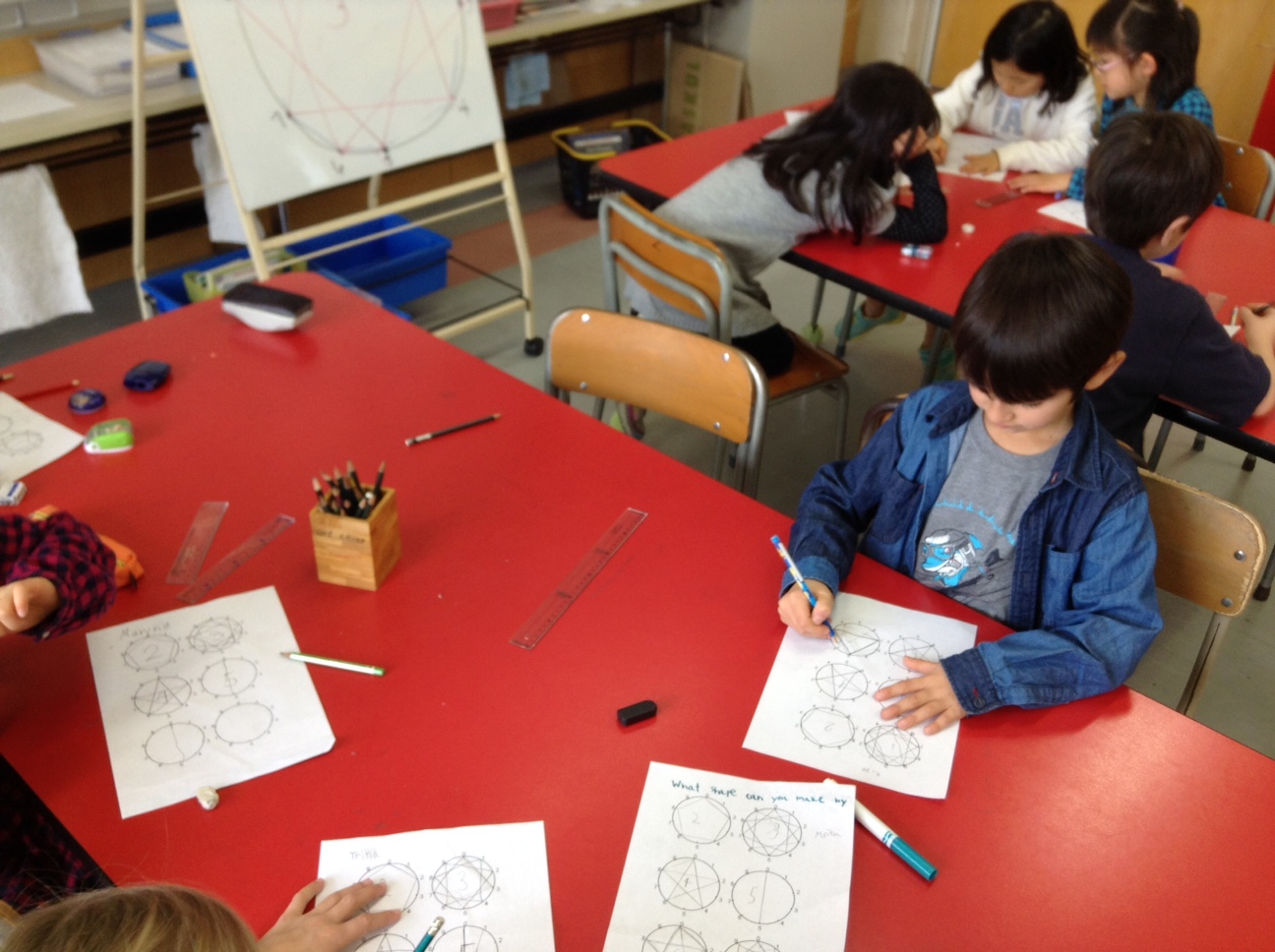
Looking for multiplication lessons for my Grade 2's, I came across an interesting way to show multiplication shapes within circles. Since I have a combined class, I thought this could work with both multiplication and skip counting (not saying that multiplication is skip counting though).

I had the following shape ready on the whiteboard when the students came in. 


Many students guessed it was a clock. Then one observant student said it wasn't, and another justified it by saying that clocks don't have 0's on them.

I asked them what they thought the shape they could get by counting by ones and connecting the dots.

They had no idea what I was talking about, so I modeled.


Then they got it. 

We went around the circle together on the white board.


I gave them a sheet with six circles prepared on it and asked them to go through the numbers as I did with the ones. That was a little hard to understand, so I modeled a few lines counting by twos for them.

The second graders were able to continue by themselves, and I worked with the first graders for a little bit allowing the ones with more confidence to leave the smaller group I was working with.


This was one of those lessons where all the students were engaged, working at their own pace, and the task was in everyone's zone of proximal development. 


A few second graders finished early so I gave them this extension problem. 

Tell me what shape you will get if you count by 8's. What is the relationship with the patterns?

Note: I have been writing drafts of blog posts, but never getting back to them. This post was to get me back into reflecting.

Saturday, September 27, 2014

This Is Disgusting ... But It's Fun

I walked into the PTA room the other day and saw a garbage can overfilled with all kinds of garbage in mixed together. On top of it all were a few plastic bottles and I thought, we need to get in this garbage. I took the garbage out of their room, and brought it into my classroom one afternoon.


The next morning when the students came in, they saw the bag of smelliness in the front of the classroom.

Why is that in here?
What is that?
Who forgot their garbage in our classroom?

I was asked a flurry of questions, but before answering them, I asked them what they saw.

Garbage!
Trash!
Junk!

Then I asked them again to look closer, and to find a partner and do a Think, Pair, Share.

From this, I started getting observations about the plastic bottles, recycling, and someone may have seen a piece of paper in there somewhere.

Then I asked what we could do about it. Someone said we should recycle the bottles. So I asked about the paper. They agreed we should recycle that too. I told them that we still can recycle some of this "junk" and I passed out some plastic gloves. (Ironic, I know.)

We went into the school's entryway where all the hallways come together. It is a large area with ceramic tile floors that can be easily cleaned if need be. 

I passed out some clipboards so they could write t-charts onto some (already used on one sided) paper. Their charts were separated into a G for garbage, Pl for plastic, and Pa for paper. The students took turns coming up and digging into the garbage and deciding which bin to put it in.

There were plenty of "EEWWs" and "OHs" during this process. I am sure that most classes heard some of this.


Soon we had the garbage separated and a pile of data. Then it was off to lunch.


When they came back from lunch, we set out using the data to make bar graphs so we could get a picture of what kind of trash we separated.

The next step in this inquiry is to write letters to the PTA to ask them to be careful about what they throw away. I am also going to stress to my students that we need to also help them, so we may ask the headmaster to give the PTA two more bins so it is easier for them to recycle.

I just thought of this, but we could also make some posters of the kinds of things they can recycle to hang in the PTA room.


*The title is a quote from one of my students during the garbage sort.

Sunday, September 21, 2014

Tracking Understanding


Since this was the second time I was teaching these units as a Grade 1-2 teacher [on a two year cycle], I wanted to change the order in which I taught them. Two school years ago, I taught our current unit, Sharing the planet: An inquiry into rights and responsibilities in the struggle to share finite resources with other people and with other living things, at the end of the year. This time, it is in the beginning.

In my classroom I have a large basket filled with scraps of paper to be used in future projects. This was a great chance to ask my students why I would have a box of paper scraps in my room. After our discussion, I put them to work making their own self portraits using the scraps of paper.

After we were done I had all these self portraits that I was planning on simply displaying. But when I put them up in a row, I noticed I could have them talk to each other. 

This evolved into a way to track student understanding through our unit. I created speech bubbles that are big enough for post-its, and periodically, I ask the question, "What do you know about our unit?"

Each time we talk about it, I put their answers into a unit page in their portfolios so we can see how they grow in their understanding and knowledge.

This might be a good opportunity next unit to develop a rubric about conceptual understanding.

Monday, September 1, 2014

Dealing With Challenging Students

I came across this article on Teach Thought entitled, "Growing Closer To Your Most Challenging Students" and it inspired me. Of course, that was last week.

When I encounter a challenging student, I try to win them over. I do this by trying to get to know them better and building a bond with him or her.

By creating this relationship, more times than not the student will settle down. I usually learn something about him or her. By understanding where the behavior issues are coming from, I have more empathy and am able to handle issues that arise with more compassion.

This is not to say that issues disappear when a relationship is built, but rather that issues are able to be met with more understanding.

Time for recess duty.