Showing posts with label science. Show all posts

Sunday, April 12, 2015

Reading to Learn in Science - Challenges of Science Texts

Some notes from a MOOC about teaching reading in Science. 

If you have ever taken a MOOC, you know the basic format - the course will have video lectures, links to further reading, and will encourage [or force] participants to use the discussion forum. This MOOC is a little different, and the professor has made short formative comprehension tasks to be answered during the videos.

I like this model, and hope to see it more in flipped learning environments.


== Notes ==

Before reading difficult [nonfiction] texts, elicit students' prior knowledge about the topic by discussing relevant topics students have learned to see if they will be able to make sense of the new ideas in the text.

"Reading to Learn" involves reflective reading skills - knowing when to reread parts of the text for clarity.
  • Visualize figurative and metaphorical language
  • Give students strategies to develop a metacognitive awareness of their reading habits.
  • Reading comprehension can be strengthened by talking and writing about what they read.

Three-Part Model to Support Reading

Pre Reading
Use an activity to activate students' prior knowledge.
improves comprehension among all students.

During Reading
Students use strategies to monitor and improve their own comprehension.
Students should know to reread and reflect.
Student-centered activities during reading improve comprehension.
Good readers naturally monitor their own comprehension.

After Reading
Strategies for organizing and summarizing the information they read.
Summarizing and organizing chunks information.


Look out for ...
  • Nominalizations - when processes are turned into nouns. These often end in -tion (i.e., evaporation) 
  • Polysemy - words with multiple meanings. For example, there are many types of "energy", and the reader needs to infer which meaning by inferring from the text.
  • Multimodality - text and images, diagrams, etc.
  • Academic Language - not science specific, but not a part of everyday language. Teachers need to be aware of words like "whereas, interactions, fundamental, emits, etc." and include these when teaching for clarity.

Three Tiers of Vocabulary
Tier 1—Basic Vocabulary
Tier 2—High Frequency/Multiple Meaning Vocabulary (academic writing)
Tier 3—Low-Frequency, Context-Specific Vocabulary


Thursday, May 2, 2013

How Does Light Move?


This picture is from way back in March.

I was being observed, had a cold, and the lesson was about how light moves.

It was one of the more interesting class periods of this year. I set up a flashlight and asked the students where they thought the light would go. To my surprise, I had kids going all around the room putting markers on the wall where they thought the light would end up when I hit the switch.

I thought that they misunderstood what I asked of them, so I repeated the question. I had them retell me the question in their own words - everything seemed fine.

We spent an hour and a half inquiring into how light moves.

I expected that part of the lesson to last 5 minutes. But, I went with where they were and had a great time.

Thank you Craig For the picture.

Edit: To get started, I had the students draw a picture of how they thought light moved, and what they drew was pretty wild. Just today, two days after I published this post, I came a cross a blog post on Inquire Within and Tasha Cowdy writes,
Unusually, the children were slow to respond and when they did, their answers were not obviously related to the question. It occurred to me that the question I had asked required the children to think abstractly about something that they had never experienced. I hadn't asked the right question, offered a meaningful invitation.
... I am reminded of the importance of framing a good research question and thinking carefully about a meaningful provocation.

Saturday, November 10, 2012

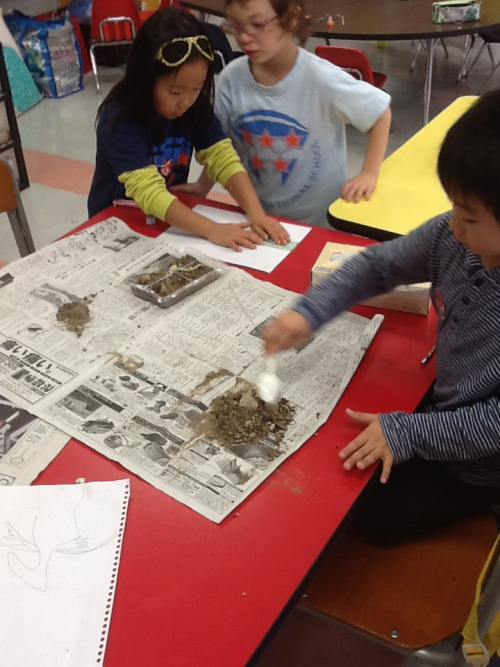
Digging Up the Past

I am trying to incorporate more hands-on activities this year; more building, more constructing, more tinkering.

To demonstrate how paleontologists retrieve bones from the ground, I put some plastic dinosaur bones in some plastic trays and buried them in dirt.

I had the trays out for a while before we did this, so the students all knew what was in them after digging in them themselves, but the purpose of this activity was not to find what was inside, but rather to be scientists and to use the clues we find to paint a picture.

I was also able to show them how to make a grid, as shown below, so they could record exactly (or as accurately as first and second graders can) what they saw.


1
2
3
A


B


C


I have more bones buried in the garden which I want to use as an activity to build on this one. That is, if the weather ever clears up.

Wednesday, May 16, 2012

Beetle Inquiry


The beetles I brought into my room (along with the box of dung I found them in) has brought on a life of its own.

To recap:
  • While digging in the pile of horse dung to use as fertilizer, I found a larvae. Knowing that my students would love it, I put it in a bucket and brought it back to the school.
  • Later that day the high school students found another one.
  • I borrowed an aquarium from the science teacher and filled it with the same stuff I found the larvae in (which I don't think he'll ever want back)
  • I offered to let anyone who wanted one to have one, and half the class said they wanted one, so I went out to the pile and got a total of ten for the class.
  • One girl said her dad raises beetles, so I told her to write me up some rules on how to take care of them (writing integrated!)
  • A boy brought in a book on beetles in his native Japanese (Japanese language integrated!)
  • The Kindergarten who are studying living things, and Grade 1-2 classes both came in to check them out.
  • The students are hypothesizing on what they will turn into using their prior knowledge and that from books to make their guesses. (I am pretty sure they will turn into kabuto mushi or rhinoceros beetles - at least that's what the maintenance guy said they would become.)
  • Today students that do not normally play together all gathered around to read about beetles.
I would like to incorporate a math problem in here somewhere, I am thinking something with volume involving dirt in the aquarium.

I don't know the first thing about these beetles and I have learned more in the past week than I ever wanted to know. I just wish that our current unit was focused on bugs. And I hope these things turn into beetles sometimes soon.

Friday, May 11, 2012

Beetle Larvae Digging


I shot this for my students the other day.

I had just brought in some beetle larvae, I set them on top of the soil in the aquarium in the classroom [we are up to ten now]. As soon as I set them down, I could see them start to dig.

I grabbed my camera and started shooting away as the larvae were digging.

I thought this would be cool to show my students even though it is only a few seconds.

Monday, March 12, 2012

The Scale of the Universe

This is a link to a website where you can move a slider and virtually move through space.


I found this and I initially shared it with our Grade 5-6 teacher since they have a unit on space. He showed it to his class and they went wild over it.

After I heard that, I showed it to my class as well. They loved it. After letting them play on it for 15 minutes or so, I started asking them questions like:
  • What is the most interesting thing on here for you?
  • What is bigger, x or y?
  • How many x's can you fit into one y?
  • If the Saturn V rocket is about the size of a football field, how long would it take you to run the length of it?

Another great feature of this site is that you can click on the objects and a fact bubble will pop up with more information.

I am going to have a think about this to see how many more ways I can use this. I am sure I can think of some big questions to use with this site.

Saturday, March 10, 2012

The Scientific Method

When I saw a Lego space shuttle being sent into the upper atmosphere, I thought it was really cool. I like to share interesting findings with my students since it gets them excited and it gets their imaginations running.
Today I decided to show the clip of the Lego ship going to space to my students. Before we watched it though, I asked them if they remembered The Scientific Method (They did) and I asked them if they remembered the experiment we did in class (They remembered that too).

Then I told them that we were going to watch something, and I was going to ask them a question after the video was done.

When the video was finished, I reviewed The Scientific Method, and I told them if what we just saw was the experiment, what would the question have been. I gave them the example of the experiment we did in class and worked backwards.

There were three girls who did not understand right away and I had to take them aside and explain it to them further. All in all though, their answers were interesting:
  • How can we fly the balloon up high without a human going with it?
  • How can we make a balloon fly high while holding things?
  • Can the Lego plane fly?
  • How high can you go with a balloon?
  • How can you see space without going there?
  • How far [high] can the airplane go?
  • How far did the balloon go?
  • Can a balloon go out of the atmosphere?
  • How far can the plane fly?
  • どこまで飛んでいたんですか? [How far did the airplane fly?]
  • Why did you throw the things?
  • Are we looking at space now?
  • How can you trick people with the picture?
Looking at these questions, I can see there are definitely a few who did not understand what I was asking even though they thought they did.
I think it is interesting that one student thought the video was fake. He said he thought it was because he could see the strings. The student did not understand what the strings were for.

I like to ask my students these kinds of abstract questions to get them to think in multiple directions.